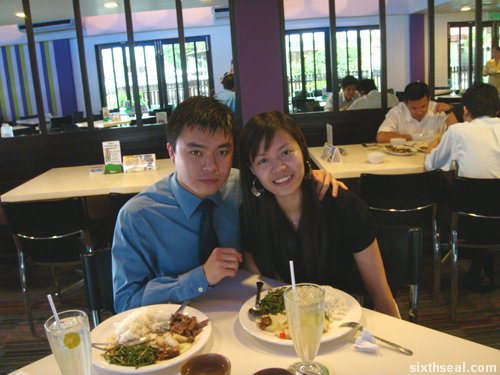
My friend of over 20 years just got married on Sunday and I was slated to be one of the “best buddy” for the groom entourage. It’s a HK tradition where the bride is barricaded (willingly, of course) inside her house along with her group of (all female) friends. This group is known as the zhi mui (sisters) while the groom team, consisting of me and a couple of others are known as the heng tai (brothers).

The mission is to get into the bride’s bedroom in her house from the groom’s house. We started arriving early in the morning to Ting Chuan’s house where the wedding preparations has already been set up the night before. The groom team is meeting up at the groom’s house before the fleet of cars led by the wedding car drives to the bride’s house.
My first question upon seeing this old friend of mine:
HB: Eh, bro, it’s your big day. Why haven’t you shaved?
TC: I did! I shaved at 12 am last night so there’ll be a stubble. It looks more manly.

Naturally, being the opportunistic person that I am, I talked to Celeste who works at Ta Ann. She was the only female in our entourage.

I got an XX Chromosome post out of it too, it’s a bit out of place in this post, but hey, someone told me weddings are the best place to meet new people. :p

Anyway, we departed for the bride’s house in several cars and arrived without the customary mass honking (which I was told was only done after the bride has been secured and transported back to the groom’s house).

There are a lot of traditions to be followed in a Chinese wedding ceremony – a piece of cloth is laid upon the wedding car and the car is reversed so it’s facing out. Lanterns (representing the future offspring) are also tied to both of the side mirrors.

The groom’s entourage (us) sat down for a meal of longevity noodles with chicken soup.

My friend (the groom) was presented with an egg each by the father and mother of the bride.

We ate at the table together – this is the meal to energize us for the task up ahead…securing the bride.
Our heng tai (brothers) entourage is expected to pass three stages before getting to the bride’s bedroom. The bottleneck is the staircase up, which is manned (womanned?) by a representative from the zhi mui (sisters), the friends of the bride.

Ang pow (red packets containing money) are expected to be given out at every stage and one of the sisters has even prepared some in advance just in case the groom didn’t have enough. Heh!

I kinda like how this one was done – the representative said that there are four stages in a married couple’s life and the groom is expected to “go through” each one metaphorically and literally in advance. The sour stage represents the arguments that will inevitably occur in every relationship and the groom has to drink a bottle of calamansi lime juice to pass that.

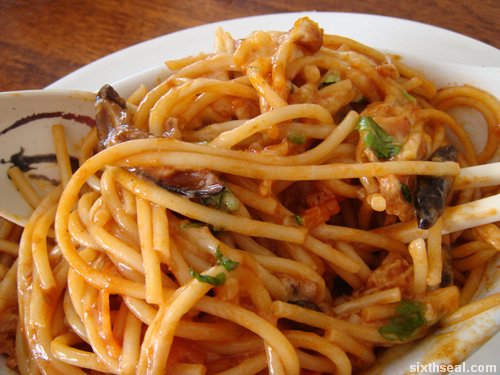
There are also questions posed at every stage, with “punishments” rendered out if the groom can’t answer the questions. Ting Chuan couldn’t remember the exact day, month, and year he met his bride-to-be and had to eat a wasabi spiked kampua. The groom has the option of asking his buddies to take the punishment for him, since there’s a lot meted out.

He passed the wasabi noodles to me and as the brother (“best buddy”), I took one for the team. It tasted quite delicious actually, but the first bite made my eyes water. They were really serious in putting the wasabi (horse radish) into the noodles. The sisters took pity on me and told me I didn’t actually have to finish it, but I did and it tasted delicious. I even asked for the recipe from them after the event. 😉

The salty stage involves the groom drinking salt water and the bitter stage is represented by bitter gourd extract. There were a lot of questions during the various stages, which he luckily got right, since they had an arsenal of wasabi laced kampua noodles up there. Thus, after the mass handing out of ang pows (red packets) to the sisters, we finally got to the final stage.
This is the sweet stage – it’s orange juice that the groom has to drink. Sour, salty, bitter, sweet. I love the imagery behind this custom. The last gauntlet was to call out for the bride and asking her for permission to enter.

The sisters finally granted access, and the door was opened.

I present – Siew Ling, the bride! 🙂

Ting Chuan has to propose formally to her and the fun isn’t quite over yet as the sisters made them kiss for 10 minutes.
It was finally negotiated down to 10 seconds, but unfortunately, I didn’t get the footage coz I was changing memory cards. It was very sweet actually, and that was the catalyst that made me want to get married.

The father of the bride escorted her down the stairs…

…and officially “handed over” his daughter.

Chinese custom has a form of ancestral worship that is widely practiced over here and the newlyweds have to bow three times to the late grandparents of the bride for blessings.

Respect is also rendered to the parents of the bride by bowing three times, upon which the mother of the bride clasps a gold necklace around the groom’s neck. This is foreign to me and I don’t know what it symbolizes.

The newlyweds proceeded out of the bride’s house…

…to pose for a group photo with relatives of the bride.

Thus, our entourage escorted the bride with a red umbrella into the car for the return trip to the groom’s house.

The wedding car drove out and reversed three (3) times before stopping for the mother of the bride to present a key to the bride. I don’t know what the accelerating and backing up of the wedding car symbolizes but the key to the bride is a token reminder for her to return home every Chinese New Year on the second day, and also taken to mean that she is welcome home at any time, even though she’s now “married out” and part of the groom’s family.

Our entourage arrived back to the groom’s residence where firecrackers were lit for the celebration.
The bride and groom have to wait until the firecrackers end before alighting from the car.

The newlyweds are the first to step into the house with their shoes on (while everyone else takes off their shoes) and bow three times into thin air. This was related to me as a request for the blessing of their matrimony by “ti gong” (a saint/god of sorts).

That being done, the bride and groom goes into their room and sits down on the marriage bed. I think this is to represent the consummating of the marriage. 😉

The exchanging of rings is done at the groom’s house…

…and the newlyweds kneel down on cushions to serve tea to the parents of the groom as a token of respect and to seek their blessing on the marriage.

The bride and groom are given a sweet soup (tong sui) to drink to mark their new journey in life together.

It was a fun experience and it really made me want to settle down and get married too. Congratulations to Siaw Ting Chuan and Wong Siew Ling on their union. Cheers bro! 🙂